
Decoding Supplement Labels: What Does % NRV (BRD) Mean for Your Health?
Content Guide
- • What is NRV? Decoding Nutrient Reference Values
- • How NRV Limits Are Established by Food Authorities
- • The Importance of Vitamin B-Complex for Daily Energy
- • Understanding Maximum Limits and Regulatory Compliance
- • How to Safely Read and Interpret Supplement Labels
- • Frequently Asked Questions
- • Scientific References and Bibliography
What is NRV? Decoding Nutrient Reference Values
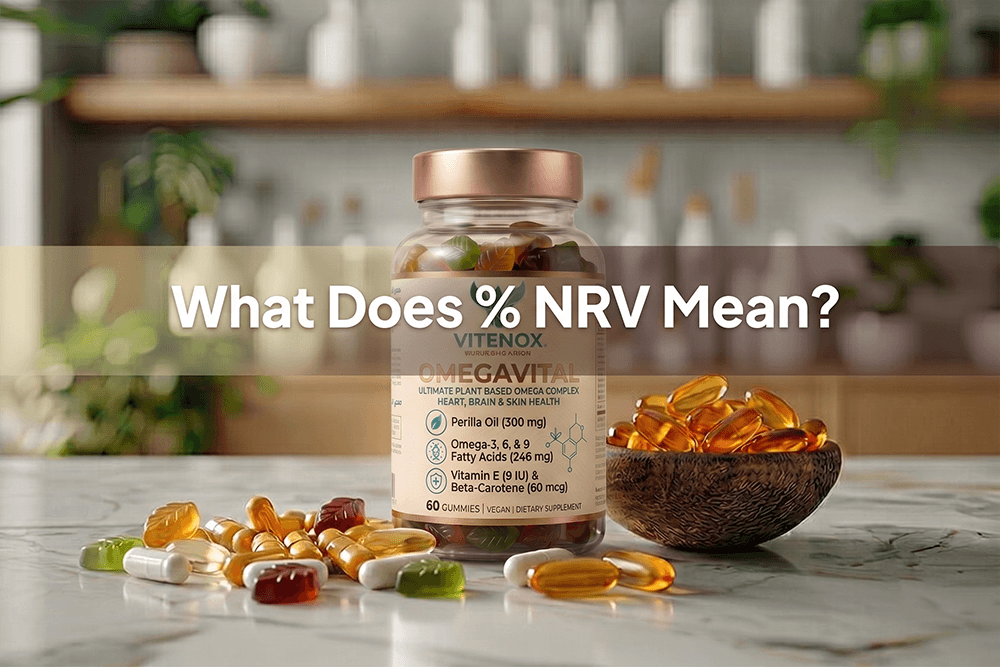
When looking at the nutritional facts table on any dietary supplement, you will see a column labeled “% NRV” or “% BRD” . NRV stands for Nutrient Reference Value, known in Turkish regulations as Beslenme Referans Değeri (BRD) . This percentage indicates how much of a specific vitamin or mineral a single serving provides relative to the recommended daily intake required to maintain standard physiological health and prevent nutritional deficiencies in an average adult .
How NRV Limits Are Established by Food Authorities
NRV values are strictly established by regulatory bodies in compliance with national and international food standards . These values represent a reliable baseline for the general population. For example, a standard formula might contain exactly 1.4 mg of Vitamin B6 to fulfill 100% of the official labeling registration reference value . However, for certain specialized botanical ingredients or unique plant compounds like Inositol or Choline, an official legal Nutrient Reference Value may not be established, which is why they appear with a double asterisk (**) on labels .
The Importance of Vitamin B-Complex for Daily Energy
B vitamins play a central role as essential coenzymes in converting food into cellular energy, supporting normal energy-yielding metabolism and enhancing vitality . High-potency B-complex supplements group these essential nutrients together to maximize natural daytime focus and reduce chronic fatigue . As outlined in the Vitenox B-Core Specification Sheet, a premium B-complex formulation provides comprehensive metabolic support by supplying high-percentage NRV values of essential vitamins:
- Niacin (Vitamin B3): Formulated at an elevated level of 60 mg NE to deliver 375% NRV, driving key metabolic pathways .
- Vitamin B1 (Thiamine) & Vitamin B2 (Riboflavin): Supplied at 5 mg (454.5% NRV) and 6 mg (428.6% NRV) respectively to optimize cellular respiration .
- Vitamin B5 (Pantothenic Acid) & Vitamin B6 (Pyridoxine): Dosed at 15 mg (250% NRV) and 6 mg (428.6% NRV) to contribute to the reduction of tiredness .
- Vitamin B12 (Cobalamin) & Folate (Vitamin B9): Provided at 9 mcg (360% NRV) and 400 mcg (200% NRV) to assist in healthy red blood cell formation .
- Biotin (Vitamin B7): Provided at 150 mcg (300% NRV) for structural tissue maintenance .
Understanding Maximum Limits and Regulatory Compliance
While some daily values exceed 100% NRV to support therapeutic or high-potency needs, regulatory frameworks enforce strict upper limits for consumer safety . According to the technical guidelines of the Restricted Substances List (Takviye Edici Gıdalar Kısıtlı Maddeler Listesi), specific ingredients have set maximum daily doses for individuals aged 11 and older . For instance, the absolute maximum allowable limit for Inositol is 2000 mg/day, Choline is capped at 550 mg/day, Vitamin B1 is limited to 100 mg/day, and Vitamin B2 cannot exceed 200 mg/day . Staying safely within these established regulatory boundaries guarantees that high-potency supplements support hepatic and neurological functions without causing toxicity .
How to Safely Read and Interpret Supplement Labels
To practice safe supplementation, consumers should always cross-reference the active ingredient amounts with the recommended serving size. For adults, it is typically recommended to take 1 capsule daily with plenty of water, preferably with a meal in the morning to maximize daytime energy production . Furthermore, ensure the physical product packaging leaves dedicated placeholder blocks for the Batch Number, Expiry Date, and Ministry Approval Number to confirm full regulatory compliance and safety .
Frequently Asked Questions
What makes a high-potency Vitamin B-complex unique?
An advanced B-complex formulation combines all eight essential B vitamins with enhanced doses of Inositol (500 mg) and Choline (50 mg), providing metabolic, neurological, and healthy liver support simultaneously .
Why do some supplements contain over 100% NRV of certain vitamins?
Water-soluble vitamins, like the B-Complex family, are safely eliminated by the body if consumed in excess of immediate cellular needs. Higher percentages are used to effectively support intense metabolic activity, manage stress, or address subclinical deficiencies under safe maximum limits .
Is a change in urine color normal when taking B vitamins?
Yes, absolutely. A bright yellow-green pigment in urine is a completely safe and natural effect of Vitamin B2 (Riboflavin), indicating that your body has absorbed the nutrient and is simply eliminating any unneeded excess safely .
Scientific References and Bibliography
1. European Food Safety Authority (EFSA). (2017). Dietary reference values for nutrients: Summary report. EFSA Supporting Publications, 14(12), e15121.
2. Institute of Medicine (US) Standing Committee on the Scientific Evaluation of Dietary Reference Intakes. (1998). Dietary Reference Intakes for Thiamin, Riboflavin, Niacin, Vitamin B6, Folate, Vitamin B12, Pantothenic Acid, Biotin, and Choline. National Academies Press (US).